MacBook Pro 16″ A2141 motherboard repair
Board diagnosis 820-01700: The unit negotiates 20V with the charger, but shows no current draw (0.00A).
A state of total paralysis
A 16-inch MacBook Pro (model A2141, 2019) arrived at our lab with a recurring symptom: sudden shutdown and refusal to power on. Connecting the unit to our USB-C diagnostic meter revealed a telling behaviour.
The CD3217 controllers are operational and negotiate the 20V supply with the charger, but the current remains inert at 0.00A. This condition usually points directly to the T2 chip. The 20V rail is present, but the T2 fails to complete its S5/S4 boot sequence, commonly due to a failure on one of its critical power rails.
.jpg "16-inch MacBook Pro (model A2141) won't power on 2")
Board-level Intervention Process
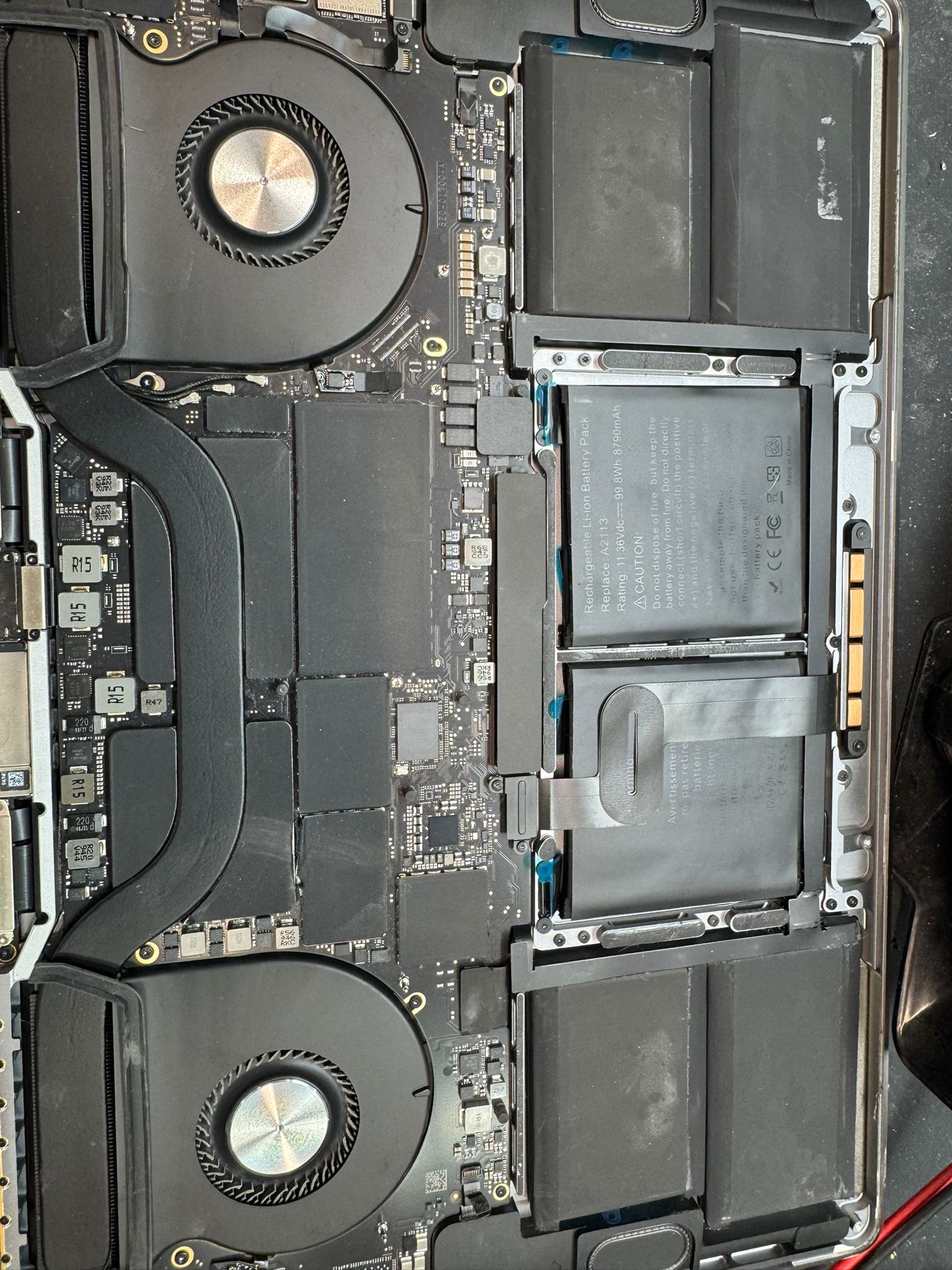
Removal of the 820-01700 logic board and component-level diagnosis.
1. Rail Measurements
The main rail PPBUS_G3H measures 12.6V, which rules out a primary hard short. We moved on to the NAND rails, essential for the T2 to load its firmware:
- PP3V3_G3H_RTC: 0.432V (OK)
- PP0V9_SSD_VCC: 0.310V (OK)
- PP2V5_NAND_VCC: 0.000V (short to ground)
Fault found: the 2.5V NAND memory rail is completely shorted to ground.
2. Thermal Injection
To avoid removing shields blindly, we injected 1V (current-limited to 2A) into PP2V5_NAND_VCC. The thermal camera revealed a hot spot immediately.
The fault was a filtering ceramic capacitor (C9586) located next to one of the NAND banks. A classic material-fatigue failure that breaches the internal layers of the SMD.
3. Microsoldering
Under the microscope we applied high-density flux and, using the hot air station at 380°C, removed the damaged capacitor. We cleaned the pads with wick and soldered an identical replacement (2.2uF, 10V, 0402).
On diode scale we measured 0.415V. The short had disappeared. When power was applied, the unit ramped current correctly and stabilised at 1.20A.
.jpg "16-inch MacBook Pro (model A2141) won't power on 3")
Laboratory Note
This A2141 case perfectly illustrates why a ‘completely dead’ unit with no current draw does not necessarily mean the CPU or T2 are fried. A single shorted SMD ceramic capacitor on a critical power rail is enough to halt the entire power sequence. Accurate diagnosis saves motherboards others might write off as irrecoverable.
Unit Recovered Successfully
After reassembly we ran stress tests with Heaven Benchmark and monitored temperature sensors for 24 continuous hours. The Mac operates stably and, most importantly, we preserved all of the client’s data intact.